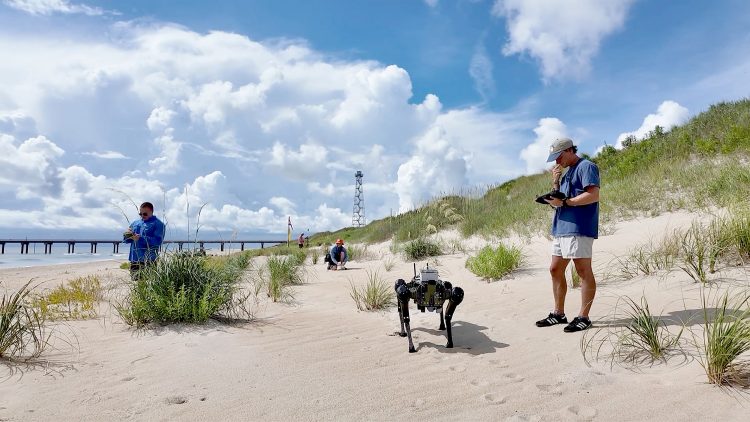
For several sweltering weeks along the North Carolina coastline, an ERDC team
pushed a quadruped robot with a suite of advanced sensors to its limit to test its ability
to conduct critical beach landscape surveys.
The research – known as the SandHound Project – is working to validate whether the
quadruped can operate at all levels of the coastal landscape and collect critical data that
one day can support emergency response and military landing operations.
We visit with Jacob Stasiewicz, a master’s student at the University of Delaware who
has worked with ERDC for the past two years, to discuss the technology, its capabilities
and its future impact on advancing coastal engineering and sciences.
Topics discussed include the genesis behind the SandHound Project and early lessons
learned (5:22); the experience of testing this robot platform on a busy, public beach
(7:18); and the future of this type of system for use across the U.S. Army Corps of
Engineers and emergency management operations (10:14). We also discussed the
types of sensors that were deployed during testing and their capabilities (12:07), the
capabilities and the expertise of ERDC’s Field Research Facility where the testing was
conducted (15:54), and the future of robotic platforms in further supporting and
advancing costal engineering and sciences (22:11).
Watch a video of this podcast on our website at PowerofERDCpodcast.org/36-sandhound_video.
For additional resources about the SandHound Project, visit
PowerofERDCpodcast.org/36-sandhound_resources.
Podcast: Play in new window | Download